
The Illusion of Affordable: EMI Mindset Trap is changing how India spends money. Learn how ₹2,999/month thinking impacts income, savings, and financial decisions—and how to regain control.
The Lie That Feels Like Relief
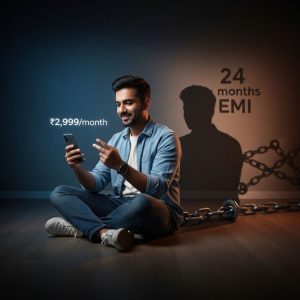
₹2,999/month doesn’t feel expensive.
That’s the point.
You don’t feel the ₹60,000 phone.
You feel the monthly drip.
Soft. Manageable. Almost invisible.
This is the psychological shift defining modern consumption—especially in India, where EMI (Equated Monthly Installment) has moved from a financial tool → default lifestyle setting.
The danger isn’t debt.
It’s a distorted perception. Because once your brain starts thinking in monthly affordability, it stops asking the only question that matters:
“Do I actually need this?”
The Illusion of Affordable: EMI Mindset Trap
1. Affordability Has Been Redefined (And You Didn’t Notice)
Earlier:
- “Can I afford this?” = Do I have the money?
Now:
- “Can I afford this?” = Can I manage the EMI?
That shift sounds small. It isn’t.
It changes:
- Decision-making
- Risk tolerance
- Consumption frequency
A ₹1 lakh purchase used to feel heavy.
Today, ₹3,999/month feels light.
Same product. Different psychology.
2. Why ₹2,999 Feels Cheap (Even When It Isn’t)
This isn’t accidental. It’s engineered.
a. Mental Accounting
Your brain treats monthly payments as “expenses,” not “cost.”
₹2,999 = just another bill
₹60,000 = serious decision
So the brain chooses the easier version.
b. Pain of Paying Is Reduced
Paying an upfront hurts.
EMIs numb that pain by:
- Splitting it
- Delaying it
- Normalizing it
Result: You spend more, feel less.
c. Anchoring Effect
You don’t compare:
- ₹60,000 vs your savings
You compare:
- ₹2,999 vs your monthly income
This makes expensive things feel reasonable.
3. EMIs Don’t Increase Purchasing Power—They Increase Consumption
Important distinction.
EMIs don’t make you richer.
They make expensive behavior easier.
You start stacking:
- Phone EMI
- Laptop EMI
- Bike EMI
- Furniture EMI
Individually manageable.
Collectively suffocating.
This is how financial pressure builds silently.
4. The Subscriptionization of Your Life
EMIs + subscriptions = fixed expense trap
Your money is pre-committed before you earn it.
Monthly outflow becomes:
- Rent
- Netflix
- Spotify
- EMIs
- Apps
- Memberships
You’re not choosing anymore.
You’re maintaining decisions you already made.
5. Why This Hits Gen Z Hardest
Gen Z didn’t grow up with:
- Delayed gratification
- Saving-first mindset
They grew up with:
- Instant access
- One-click checkout
- “Buy Now, Pay Later”
So EMI isn’t a fallback.
It’s the default.
And when everything is available instantly,
waiting starts to feel like losing.
6. The Emotional Cost No One Talks About
EMIs don’t just affect your wallet.
They affect:
- Stress levels
- Risk-taking ability
- Career choices
When your monthly commitments are high:
- You can’t take breaks
- You can’t experiment
- You can’t say no
You become financially less flexible.
7. The “I Deserve This” Loop
This is where it gets dangerous.
EMI + emotion = justification
Bad day? → “I deserve this”
Peer upgrade? → “I deserve this”
Sale notification? → “I deserve this”
Because it’s “just ₹2,999/month,”
The brain stops resisting.
8. How Brands Design This Trap Perfectly
Modern pricing isn’t random.
It’s optimized for:
- Monthly comfort
- Emotional acceptance
- Low resistance
You’ll rarely see:
₹59,999
You’ll see:
₹2,999/month
Because brands know:
You don’t buy products. You accept payments.
9. The Hidden Math You Ignore
Let’s simplify:
₹3,000/month × 24 months = ₹72,000
You didn’t buy a ₹60K product.
You bought a ₹72K commitment.
Add interest + stacking = long-term leakage.
10. So What Should You Do Instead?
Not “avoid EMIs completely.”
That’s unrealistic.
But you need control back.
1. Reverse the Question
Don’t ask:
Can I afford the EMI?
Ask:
Would I still buy this if I had to pay full today?
If the answer is no → don’t buy.
2. Use the 24-Hour Rule
Anything above ₹5,000:
- Wait 24 hours
- Revisit the decision
Impulse fades. Clarity increases.
3. Limit Active EMIs
Set a rule:
Max 1–2 EMIs at a time
Not 5. Not 7.
4. Track Total Cost, Not Monthly Cost
Train your brain to see:
- Full price
- Total outflow
- Interest
Not just the EMI.
5. Create Friction
Make spending harder:
- Remove saved cards
- Disable one-click payments
Ease leads to excess.
6. Build Awareness Systems
This is where tools like ZiHERO come in naturally.
Not as a budgeting app, but as a decision-awareness layer—
helping you see:
- Where money is silently leaking
- What habits are repeating
- Which “small” spends are stacking
Because awareness changes behavior faster than restriction.
11. The Real Problem Isn’t EMI. It’s Automation Without Awareness
EMIs aren’t evil.
Unconscious EMIs are.
The issue isn’t:
- Paying monthly
It’s:
- Not realizing what those payments are doing to your behavior
12. The Future of Money Decisions (2026 and Beyond)
We’re moving toward:
- Faster payments
- Invisible transactions
- Frictionless spending
Which means:
The biggest financial skill won’t be earning more.
It will be slowing down decisions.
Final Thought
₹2,999/month isn’t cheap.
It’s just quiet.
And quiet expenses are the most dangerous ones—
because they don’t trigger resistance.
They build slowly.
Silently.
Systematically.
Until one day you realize:
You didn’t lose money in big decisions.
You lost it in small ones that felt harmless.EMI Affordability Trap: How Monthly Thinking Is Rewiring Your Financial Decisions
Introduction: The EMI Affordability Trap Starts Here
The EMI affordability trap doesn’t feel like a problem.
It feels like relief.
You don’t feel the ₹80,000 purchase.
You feel ₹3,200/month.And that one shift—from total cost to monthly comfort—is quietly changing how an entire generation relates to money.
In India, EMIs have gone from:
- Emergency tool
to- Default buying behavior
But here’s the truth:
The EMI affordability trap is not about debt.
It’s about how your brain is being trained to accept more than you can sustain.1. The Rise of the EMI Affordability Trap in India
The EMI affordability trap is growing because of three forces:
1. Easy Credit Access
- BNPL
- Zero down payment
- Instant approvals
2. Lifestyle Pressure
- Social media upgrades
- Peer comparison
- “You deserve it” culture
3. Income Illusion
Your income hasn’t grown as fast as your access to spending has.
This gap is where the EMI affordability trap thrives.
2. Income vs EMI: The Most Ignored Financial Equation
: global trends in consumer credit usage
Let’s talk about something people avoid:
Your income is fixed.
Your EMIs are expandable.This is the core of the EMI affordability trap.
Example:
Monthly income: ₹50,000
EMIs:
- Phone: ₹3,000
- Bike: ₹5,000
- Laptop: ₹2,500
- Furniture: ₹2,000
Total EMI = ₹12,500
That’s 25% of your income already locked.
Now add:
- Rent
- Food
- Subscriptions
- Travel
You’re left with almost nothing.
The Dangerous Shift
The EMI affordability trap makes you think:
“I can manage this.”
But what you’re actually doing is:
Pre-spending your future income.
3. Why the EMI Affordability Trap Feels Safe
a. Monthly Framing
₹3,000 feels harmless
₹72,000 feels seriousSo the brain chooses the easier interpretation.
b. Income Anchoring
You compare EMI with salary
Not with savings₹3,000 vs ₹50,000 = “fine”
₹72,000 vs savings = “risky”c. Delayed Pain
The EMI affordability trap removes immediate consequences.
No pain → No resistance → More spending
4. How Income Growth Makes the EMI Trap Worse and the rising household debt trends in India
Here’s a paradox:
When income increases,
the EMI affordability trap becomes stronger.Why?
Because:
- Higher salary = higher eligibility
- Higher eligibility = bigger EMIs
- Bigger EMIs = higher commitments
So instead of:
Income ↑ → Savings ↑You get:
Income ↑ → Lifestyle ↑ → EMIs ↑ → Savings = 0This is called:
Lifestyle Inflation Powered by EMI
And it keeps you stuck at the same financial level—no matter how much you earn.
5. The Silent Killers: Multiple Small EMIs
The EMI affordability trap rarely shows up as one big mistake.
It shows up as:
- 6 small EMIs
- 4 subscriptions
- 3 auto-debits
Individually manageable.
Collectively suffocating.Example:
₹2,999 × 5 commitments = ₹15,000/month
That’s not small anymore.
6. EMI vs Income Ratio: The Rule Nobody Follows
A healthy financial structure:
- EMIs ≤ 20% of income
But in the EMI affordability trap, people go:
- 30%
- 40%
- even 50%
At that point:
You’re not earning to grow.
You’re earning to maintain past decisions.7. The Psychological Rewiring Caused by EMIs
The EMI affordability trap doesn’t just affect money.
It changes behavior:
1. Reduced Risk-Taking
You can’t quit
You can’t experiment
You can’t slow downBecause EMIs are waiting.
2. Increased Stress
Even if income is decent
Commitments create pressure3. Decision Fatigue
Too many payments → mental overload
4. Loss of Freedom
Your future income is already assigned
8. Why Gen Z Falls Deeper Into the EMI Affordability Trap
Gen Z:
- Earns early
- Spends faster
- Adopts trends quicker
And most importantly:
They normalize EMIs as:
“This is just how buying works.”
The Real Risk:
If EMI becomes default thinking,
saving becomes unnatural behavior.9. The Hidden Cost: Opportunity Loss
Let’s say:
₹10,000 EMI/month
Instead invested for 5 years →
Could become ₹8–10 lakhs (approx with compounding)But in the EMI affordability trap:
That money is locked in consumption.You’re not just spending money.
You’re losing future wealth.
10. Breaking the EMI Affordability Trap (Actionable)
1. Think in Total Cost (Always)
Train your brain:
Not ₹3,000/month
But ₹72,000 total2. Income Protection Rule
Before any EMI ask:
Will this reduce my flexibility?
If yes → avoid
3. EMI Cap Rule
Max 2 EMIs at a time
Not more.
4. 24-Hour Pause Rule
Anything above ₹5,000
Wait 24 hours5. Reverse Affordability Test
Ask:
If EMI didn’t exist, would I still buy this?
If no → skip
6. Awareness Systems
This is where platforms like ZiHERO come in quietly.
Not to restrict spending
But to expose patterns:
- Where income is leaking
- How EMIs are stacking
- Which decisions repeat
Because once you see it clearly,
you stop falling into the EMI affordability trap automatically.11. The Future: Income Won’t Save You—Decisions Will
Why saving feels impossible in 2026
In 2026:
- Income opportunities will increase
- Credit access will explode
- Payments will become invisible
Which means:
The EMI affordability trap will become deeper.
The only advantage?
People who:
- Think slowly
- Decide consciously
- Track behavior
Final Thought
The EMI affordability trap doesn’t make you poor overnight.
It does something worse.
It makes you:
- Comfortable
- Committed
- Stuck
All at the same time. You don’t lose money in big decisions.
You lose it in the small monthly agreements you stop questioning.
The EMI Affordability Trap : Now With Reality + Sarcasm
12. Your EMI Isn’t “Just ₹2,999” — It’s a Subscription to Stress
Let’s be honest.
You don’t have a phone EMI.
You have:
- Phone EMI
- “I’ll upgrade next year anyway” EMI
- “Why is my bank balance always low?” EMI
And somehow, every month ends with:
“Where did my money go?”
Your bank statement is basically a Netflix series:
- Episode 1: Salary credited
- Episode 2: Auto-debits attack
- Episode 3: Confusion
- Episode 4: Regret
- Episode 5: Swear to save next month
- Season 2 repeats automatically
No subscription needed. Already active.
13. The ‘It’s Only ₹X Per Month’ Scam Your Brain Falls For Every Time and How Gen Z is Earning but Still Feels Broke
Marketing teams deserve awards.
Not Oscars. Not Grammys.
EMIs.
Because they figured out the ultimate hack:
Humans don’t fear big numbers.
They fear big immediate payments.
So instead of saying:
“Pay ₹60,000”
They say:
“Pay ₹2,999/month”
And your brain goes:
“That’s less than my weekend food bill. Approved.”
Congratulations. You just compared a 2-year financial commitment with butter chicken.
14. EMI Math vs Real Life Math
EMI Math:
- ₹2,999 = small
- ₹3,499 = still okay
- ₹4,999 = manageable
Real Life Math:
- ₹2,999 + ₹3,499 + ₹4,999 = “Why am I stressed?”
Bonus Reality:
You:
“I’ll just take one EMI.”
Also you (3 months later):
- “Laptop needed for productivity”
- “Phone needed for camera”
- “Headphones needed for focus”
- “Chair needed for posture”
Now you’re fully optimized… and financially immobilized.
Your small decisions that quietly drain your money.
15. The ‘Future Me Will Handle It’ Strategy (Spoiler: Future You Is Tired)
Every EMI decision includes one silent assumption:
“Future me will handle this.”
Future you:
- Still has same job
- Same salary
- Same rent
- Now 5 more EMIs
And also:
“Past me was an idiot.”
But here’s the twist:
Present you is already becoming that “past idiot” for future you.
It’s a time-travel problem. Just without the cool sci-fi visuals.
16. The Indian Parent vs EMI Culture
Indian parents:
“If you can’t afford it, don’t buy it.”
Gen Z:
“I can afford ₹2,999/month.”
Parents:
“That’s not affording. That’s stretching.”
Gen Z:
“No, it’s optimizing.”
Bank:
“It’s profitable.”
17. The Great EMI Illusion: Feeling Rich While Being Committed
EMIs create a very unique financial personality:
You feel:
- Upgraded
- Modern
- Successful
But also:
- Stressed
- Restricted
- Confused
It’s like wearing branded clothes… on borrowed confidence.
18. EMI = Adult Version of ‘I’ll Pay You Later’
Remember childhood?
“I’ll give it tomorrow.”
That “tomorrow” never came.
Now it has evolved into:
“I’ll pay monthly.”
And this time, tomorrow does come.
Every. Single. Month.
19. Your Salary Is Not Yours Anymore (It Has Pre-Bookings)
Salary day used to feel like:
“I earned this.”
Now it feels like:
“Let’s see what’s left after everyone takes their share.”
Your income arrives…
And immediately:
- Bank takes EMI
- Apps take subscriptions
- Rent takes dignity
You just stand there like:
“Cool cool cool… I’ll survive on vibes.”
20. The ‘Zero Cost EMI’ Joke Nobody Questions
“Zero Cost EMI”
Translation:
“We’ve already adjusted the cost. Don’t overthink it.”
But you don’t question it.
Because the real product isn’t the phone.
It’s:
Comfort without guilt
And that sells better than anything.
21. When ₹2,999 Becomes Your Personality

At some point, your life becomes:
- Gym EMI
- Course EMI
- Gadget EMI
- Furniture EMI
You’re not managing money anymore.
You’re managing installments of your identity.
22. The Real Flex in 2026
Earlier flex:
- “I bought this.”
Now flex:
- “I don’t owe money on anything.”
Silence.
Respect.
Confusion from others:
“But… how?”
23. The ‘I Deserve This’ Economy
Let’s decode this dangerous sentence:
“I deserve this.”
Yes, you do.
But:
- Do you deserve the stress?
- Do you deserve the commitment?
- Do you deserve reduced freedom?
Because EMI doesn’t just give you the product.
It gives you the full emotional package.
24. The Moment of Realization (Usually Late, Always Painful)
It hits randomly.
Not during purchase.
Not during checkout.
But during a normal month when:
- Expenses rise
- Salary feels smaller
- Options feel limited
And suddenly:
“Why am I stuck?”
Answer:
Because you optimized comfort… not control.
25. The Exit Plan (Without Becoming a Monk)
Relax. You don’t have to:
- Delete all apps
- Stop enjoying life
- Live like it’s 1995
Just don’t be financially sleepwalking.
Try this instead:
- Before EMI: feel the full price
- Before buying: imagine paying upfront
- Before committing: count existing EMIs
And occasionally ask:
“Am I buying this… or renting my future peace?”
26. Awareness Is the Only Upgrade That Doesn’t Need EMI
This is where something like ZiHERO quietly matters.
Not as:
“Track your expenses bro”
But as:
“See your patterns before they become problems”
Because nobody plans to fall into the EMI affordability trap.
They just:
- Don’t notice it early
- Don’t question it often
- Don’t track it clearly
₹2,999/month is not cheap.
It’s just:
- Polite
- Friendly
- Non-threatening
Like that one friend who says:
“Bro it’s chill, we’ll split later.”
And somehow, you always end up paying more.
The EMI affordability trap doesn’t look like a mistake.
It looks like a good decision—repeated too many times.