
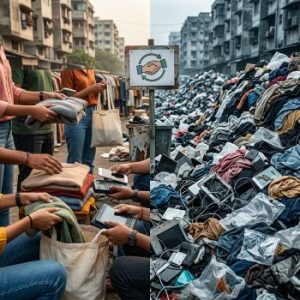
The Environmental Cost of Endless Shopping

The Environmental Cost of Endless Shopping

Table of Contents

The Environmental Cost of Endless Shopping

Here are the latest verified statistics and reports showing how the constant purchase of new products harms the environment and the economy.

1. Global Circular Economy Is Getting Worse

The latest Circularity Gap Report 2025 shows that only 6.9% of materials used globally come from recycled sources, down from 7.2% previously. That means over 93% of materials are still virgin resources extracted directly from the planet.

The report also states that:

Global material consumption has exceeded 100 billion tonnes annually
Consumption growth is now faster than recycling capacity
Nearly 500 billion tonnes of materials were consumed in the last five years alone

This proves that buying and replacing products faster than ever is outpacing sustainability efforts.

2. Textile Waste Is Rising Rapidly

A 2025 report by Boston Consulting Group estimated that the world discarded 120 million metric tons of clothing in 2024.

Key findings:

Around 80% of discarded clothing ends up in landfills or incinerators
Only 12% is reused
Less than 1% is recycled into new clothing fibers

The report directly links this waste explosion to:

Fast fashion
Shorter clothing use cycles
Consumers buying more but wearing items less often

As younger consumers rethink ownership and waste, platforms like ZiHERO reflect a growing shift toward smarter spending, resale culture, swapping, and extending product life instead of constantly replacing items.

3. Fashion Industry Emissions Continue to Grow

The Environmental Cost of Endless Shopping. Recent sustainability discussions and industry reports estimate the fashion industry contributes around 8–10% of global CO₂ emissions.

Additionally:

Polyester now accounts for over 50% of global fiber production
Textile production remains one of the largest industrial water consumers globally

This means trend-driven shopping habits are directly increasing climate emissions.

4. E-Waste Is Becoming a Major Global Crisis

Recent studies highlight that electronic waste is one of the fastest-growing waste streams worldwide.

According to recent research:

India generated over 1.7 million tonnes of e-waste in 2023–24
Less than half was formally processed or recycled

Globally:

E-waste continues to rise because of shorter device lifecycles
Frequent phone, laptop, and gadget upgrades are accelerating toxic waste generation

Electronic products contain:

Lithium
Mercury
Lead
Rare earth metals

Improper disposal contaminates soil and groundwater.

5. Buildings and Consumer Growth Increase Emissions

A 2025 UN-related climate discussion found:

Buildings and construction contribute 34% of global carbon emissions
The sector also produces nearly one-third of global waste

Consumer demand for:

New homes
Renovations
Furniture
Appliances

continues to increase extraction of steel, cement, plastics, and timber.

Latest Consumer Trends Driving the Problem

Recent sustainability research shows consumers are:

Buying more frequently
Keeping products for shorter periods
Replacing functioning goods due to trends or upgrades
Influenced heavily by social media marketing and “haul culture”

Fast fashion and electronics industries especially rely on:

Planned obsolescence
Rapid trend cycles
Psychological pressure to upgrade
Economic Impact of Constantly Buying New
Households Spend More on Replacements

Short product lifespans force repeated purchases:

Phones every 2–3 years
Cheap clothing every season
Appliances replaced instead of repaired

This reduces long-term savings and increases household debt.

Governments Face Rising Waste Costs

More waste means:

Larger landfill expansion
Higher recycling costs
Increased pollution cleanup expenses

Taxpayers ultimately fund much of this infrastructure.

Valuable Resources Are Lost

Modern waste contains valuable materials like:

Gold
Copper
Lithium
Aluminum

Yet most products are discarded before materials are recovered efficiently.

Key 2025–2026 Statistics Summary
Topic Latest Data
Global circular economy rate 6.9%
Global material use annually 100+ billion tonnes
Clothing discarded yearly 120 million tonnes
Clothing recycled into new fibers Less than 1%
Textile waste landfilled/incinerated ~80%
Fashion industry emissions 8–10% global CO₂
India e-waste (2023–24) 1.7 million tonnes
Global recycled material share Declining despite recycling growth

FAQs
Why is buying new products unsustainable?

Because manufacturing new products consumes raw materials, water, energy, and transportation resources while generating pollution and waste.

What industries are the biggest contributors?

The largest contributors include:

Fast fashion
Consumer electronics
Construction
Packaging industries

Is recycling enough?

No. Experts increasingly emphasize that reducing consumption and extending product lifespans are more effective than relying only on recycling.

Why do companies encourage frequent replacement?

Many industries depend on repeat purchases for profit. Strategies include:

Trend cycles
Software obsolescence
Non-repairable designs
Aggressive advertising

What can consumers do?

People can reduce impact by:

Buying durable products
Repairing instead of replacing
Choosing second-hand goods
Supporting circular economy brands
Avoiding impulse purchases

Conclusion

Recent 2025–2026 data clearly shows that the global economy is becoming more resource-intensive, not less. Despite improvements in recycling technology, rising consumption continues to overwhelm sustainability efforts.

The habit of constantly buying new products is no longer just a personal choice—it has become a major environmental and economic issue affecting climate change, waste generation, and resource security worldwide.
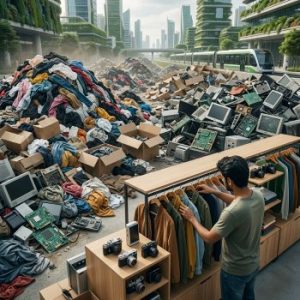
How Other Countries Are Taking Action — And Why India Is Still Falling Behind

While the environmental damage caused by overconsumption has become a global concern, many countries have already begun transforming their economies through strict sustainability laws, circular economy policies, and “right-to-repair” reforms. In contrast, India—despite being one of the world’s fastest-growing consumer markets—is still struggling with weak enforcement, informal waste systems, and a culture of rapid consumption.

The difference is becoming increasingly visible.

Countries across Europe and East Asia are now treating waste reduction as a national economic strategy. India, however, continues to prioritize short-term consumption growth over long-term sustainability planning.

Europe’s Circular Economy Revolution

The European Union has emerged as the global leader in fighting overconsumption and waste.

Rather than relying only on recycling, the EU is redesigning how products are made, sold, repaired, reused, and disposed of.

1. Europe’s “Right to Repair” Law

In 2024, the European Union officially approved its landmark “Right to Repair” directive. The law gives consumers stronger rights to repair defective products instead of replacing them.

The directive requires:

  • Manufacturers to provide repair services
  • Easier access to spare parts
  • Better repair information for consumers
  • Affordable repair options
  • Online repair platforms

The EU estimates that premature disposal of products currently generates:

  • 35 million tonnes of waste annually
  • 261 million tonnes of greenhouse gases
  • 30 million tonnes of unnecessary resource use every year

This is a major shift away from the “buy new” economy.

For decades, companies profited by making products difficult or expensive to repair. Europe is now directly challenging that model.

Why This Matters

The Right-to-Repair movement changes consumer behavior fundamentally:

  • Consumers keep products longer
  • Repair businesses grow
  • Electronic waste declines
  • Manufacturing pressure decreases
  • Resource extraction slows down

Instead of encouraging endless replacement cycles, Europe is promoting product longevity.

India has discussed similar ideas, but implementation remains weak and fragmented.

Europe’s Strict Textile Waste Rules

The EU is also aggressively targeting fast fashion and textile waste.

From January 2025, all EU member states must establish separate textile waste collection systems.

This means:

  • Clothes cannot simply be mixed with regular garbage
  • Textile recycling infrastructure must expand
  • Companies face greater responsibility for waste

In February 2025, the EU also agreed on new waste textile rules aimed at reducing fashion waste and promoting producer accountability.

Europe Is Moving Toward Producer Responsibility

The EU increasingly follows the “polluter pays” principle.

Under newer circular economy frameworks:

  • Brands may become responsible for post-consumer textile waste
  • Companies are pressured to design recyclable clothing
  • Unsold products face stricter disposal regulations

Europe is recognizing that fast fashion’s low prices hide enormous environmental costs.

The EU’s Eco design Strategy

Another major reform is Europe’s Ecodesign for Sustainable Products Regulation (ESPR), which came into force in 2024.

The regulation aims to make products:

  • More durable
  • Easier to repair
  • More recyclable
  • More energy efficient

Companies may soon be required to disclose:

  • Product lifespan
  • Repairability scores
  • Environmental impacts
  • Material composition

This transforms sustainability into a competitive market factor.

Consumers can make informed choices rather than being manipulated into constant upgrades.

Japan’s Longstanding Recycling Culture

Japan has approached the issue differently but equally seriously.

The country has spent decades building a culture of:

  • Repair
  • Reuse
  • Minimal waste
  • Efficient recycling

Japan’s Home Appliance Recycling Law requires consumers and manufacturers to properly recycle appliances like:

  • TVs
  • Air conditioners
  • Washing machines
  • Refrigerators

Manufacturers must recover useful materials from discarded electronics.

Why Japan Succeeds

Japan combines:

  • Strict regulation
  • Public discipline
  • High civic awareness
  • Efficient waste segregation

Consumers are socially conditioned to value durability and maintenance.

In many Japanese households:

  • Products are repaired rather than discarded
  • Minimalism is culturally respected
  • Second-hand markets are normalized

This sharply contrasts with fast-fashion-heavy, upgrade-driven consumer culture elsewhere.

Scandinavian Countries: Repair Before Replace

Countries like Sweden, Denmark, and Finland have introduced financial incentives for repair-based economies.

Some measures include:

  • Reduced taxes on repair services
  • Support for second-hand marketplaces
  • Circular economy investment funds
  • Public awareness campaigns

Sweden, for example, reduced taxes on repairs for bicycles, clothes, and household appliances to encourage reuse over replacement.

The logic is simple:
Repairing products creates jobs while reducing waste.

France’s Anti-Waste Laws

France has introduced some of the world’s strongest anti-waste laws.

The country now requires certain electronics to carry a “repairability index,” showing consumers how easy products are to repair.

France also banned companies from destroying unsold non-food products, including:

  • Clothing
  • Cosmetics
  • Electronics

Instead, businesses must:

  • Donate
  • Recycle
  • Reuse

This directly attacks the wasteful culture of overproduction.

South Korea’s Recycling and Food Waste Success

South Korea has built one of the world’s most advanced waste-management systems.

The country:

  • Recycles the majority of its food waste
  • Uses RFID waste tracking systems
  • Charges households based on waste generation
  • Invests heavily in urban recycling infrastructure

Consumers are financially incentivized to reduce waste.

This creates accountability at both corporate and household levels.

China’s Shift Toward Circular Manufacturing

China was once known mainly as the world’s manufacturing center, but it is now investing heavily in circular economy systems.

The country has:

  • Restricted certain waste imports
  • Expanded electric recycling industries
  • Increased environmental regulation
  • Promoted green manufacturing

China understands that unchecked industrial waste threatens both public health and long-term economic stability.

Why India Is Falling Behind

India is one of the world’s largest markets for:

  • Smartphones
  • Fast fashion
  • Consumer electronics
  • Cheap household goods

However, waste management systems have not evolved at the same speed.

The result is a growing environmental crisis.

India’s E-Waste Crisis

India generated over 1.7 million tonnes of e-waste in 2023–24, making it one of the world’s largest e-waste producers. Yet less than half is formally processed.

Much of India’s e-waste still moves through:

  • Informal scrap networks
  • Unsafe dismantling operations
  • Unregulated recycling hubs

This creates:

  • Toxic air pollution
  • Water contamination
  • Worker health hazards

The National Green Tribunal recently expressed concern that 17 Indian states and union territories still lack adequate e-waste recycling plants.

Even Delhi reportedly lacks registered recycling units despite producing massive amounts of e-waste.

The Informal Sector Dominates Recycling

Unlike Europe or Japan, India’s recycling system relies heavily on the informal sector.

Kabadiwalas and scrap dealers handle a huge share of recyclable waste.

While they play an essential economic role, most operations lack:

  • Safety standards
  • Environmental protections
  • Modern recycling infrastructure

Some estimates suggest over 95% of e-waste in India passes through informal channels.

This creates dangerous conditions:

  • Open burning of wires
  • Acid extraction of metals
  • Toxic exposure for workers

Children and low-income laborers are often exposed to hazardous chemicals.

Fast Fashion Waste in India

India has become both:

  • A major textile producer
  • A global destination for discarded clothing

Cities like Panipat process enormous amounts of textile waste from around the world. However, investigations show workers often suffer from:

  • Respiratory diseases
  • Chemical exposure
  • Unsafe factory conditions

Factories processing synthetic textile waste expose workers to microfibers and toxic dust.

Unlike the EU, India still lacks strong nationwide textile waste segregation and producer accountability systems.

Weak Enforcement Remains a Major Problem

India has introduced policies such as:

  • E-Waste Management Rules
  • Extended Producer Responsibility (EPR)
  • Plastic waste regulations

However, enforcement remains inconsistent.

Challenges include:

  • Corruption
  • Poor monitoring
  • Lack of infrastructure
  • Informal market dominance
  • Low public awareness

Even when laws exist on paper, implementation often fails.

Consumer Culture Is Changing Faster Than Policy

India’s middle class is expanding rapidly.

This has created:

  • Massive smartphone demand
  • Fast fashion growth
  • E-commerce consumption
  • Disposable product culture

Social media and influencer marketing intensify pressure to constantly upgrade lifestyles.

The problem is that India is adopting Western-style consumption patterns without first building Western-style waste systems.

Repair Culture Is Declining

Ironically, India historically had a strong repair culture.

Earlier generations commonly:

  • Repaired electronics
  • Reused clothing
  • Maintained household items for years

But modern consumer markets increasingly reward replacement instead of maintenance.

Cheap imports often make repair economically unattractive.

As a result:

  • Durable local craftsmanship declines
  • Repair businesses disappear
  • Waste generation increases

Infrastructure Is Not Keeping Up

India’s urban infrastructure struggles to handle:

  • Plastic waste
  • Textile waste
  • Electronic waste
  • Packaging waste
  • Landfills near major cities are growing rapidly.
  • The Environmental Cost of Endless Shopping

Many municipalities lack:

  • Segregation systems
  • Modern recycling plants
  • Public awareness programs

Meanwhile, developed nations are investing billions into circular economy infrastructure.

Public Awareness Is Still Limited

In Europe and Japan, sustainability is increasingly mainstream.

Consumers actively discuss:

  • Repairability
  • Carbon footprints
  • Sustainable brands
  • Product lifespan

In India, environmental awareness is growing but remains secondary for many consumers compared to:

  • Price
  • Status
  • Trends
  • Convenience

Without widespread awareness, policy changes alone may not succeed.

India’s Opportunity

Despite these challenges, India also has enormous potential.

The country could become a global leader in:

  • Circular manufacturing
  • Repair economies
  • Recycling innovation
  • Sustainable textiles

India already has:

  • A strong reuse tradition
  • Skilled repair workers
  • Large recycling networks
  • Growing environmental awareness

Some startups are already started working towards it. Instead of products sitting unused or being discarded quickly, marketplaces such as ZiHERO support value circulation by helping people buy, sell, and swap more intelligently.

If properly modernized and regulated, these strengths could become powerful economic advantages.

What India Needs To Do

1. Strengthen Right-to-Repair Laws

Consumers should have easier access to:

  • Spare parts
  • Repair manuals
  • Affordable repair services

2. Formalize the Informal Recycling Sector

Kabadiwalas and waste workers should be:

  • Trained
  • Certified
  • Protected
  • Integrated into formal systems

3. Invest in Recycling Infrastructure

India needs:

  • More e-waste plants
  • Textile recycling centers
  • Waste segregation systems
  • Safer processing technologies

4. Hold Companies Accountable

Brands should face stricter responsibility for:

  • Product waste
  • Packaging
  • Repairability
  • Recycling targets

5. Promote Sustainable Consumer Awareness

Public campaigns should encourage:

  • Reuse
  • Repair
  • Minimalism
  • Responsible consumption

Final Conclusion

The world is slowly realizing that endless consumption is economically and environmentally unsustainable. Europe, Japan, and several other countries are already redesigning their economies around repair, reuse, and circular production.

India, however, remains caught between rapid consumer growth and inadequate waste management systems.

The country still has time to change direction.

If India continues following a “buy-use-discard” model without major reforms, the environmental and economic costs could become overwhelming. But if it invests in circular economy systems now, India could transform its traditional repair culture into one of the strongest sustainability models in the world.

Leave a Comment

Your email address will not be published. Required fields are marked *

Scroll to Top