
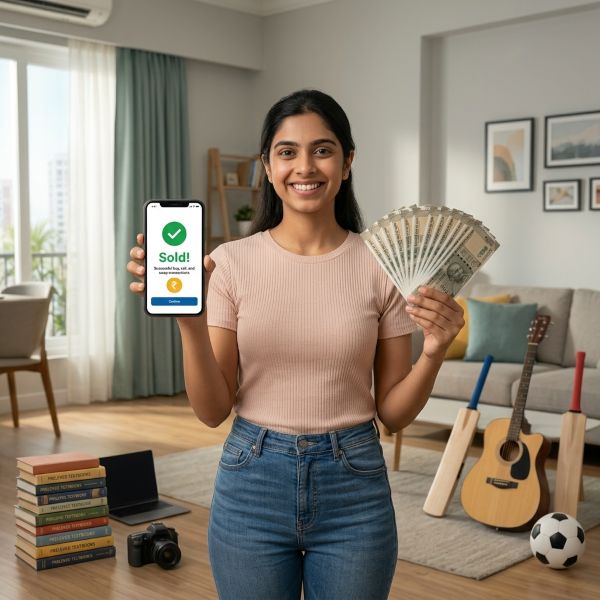
Indian consumers buying, selling and swapping products through an online marketplace to save money and reduce waste
Discover why more Indians are choosing to buy, sell, and swap products online. Learn how online marketplaces save money, reduce waste, and create new income opportunities.
The Buy, Sell & Swap Economy
India is experiencing a quiet revolution in the way people shop.
For decades, the traditional cycle was simple: visit a store, buy a product, use it, and eventually replace it with a newer version. Today, however, consumers are embracing a smarter alternative—one that focuses on buying, selling, and swapping goods through online marketplaces.
Whether it’s a student looking for affordable furniture, a young professional selling unused electronics, or a family swapping items they no longer need, the buy-sell-swap economy is rapidly transforming consumer behavior across India.
The shift isn’t just about convenience. It’s about saving money, earning extra income, reducing waste, and making smarter financial decisions.
As inflation continues to impact household budgets and consumers become more conscious about sustainability, online marketplaces are becoming a preferred choice over traditional shopping.
What Is the Buy, Sell & Swap Economy?
The buy-sell-swap economy refers to a marketplace model where individuals can:
- Buy products directly from other users
- Sell items they no longer need
- Swap goods without spending money
- Negotiate prices directly
- Extend the life cycle of products
Instead of products ending up unused in storage or being thrown away, they continue creating value for new owners.
This approach benefits everyone involved:
- Sellers recover money from unused items.
- Buyers save money compared to retail prices.
- Communities reduce waste.
- Products stay in circulation longer.
Why Indians Are Embracing Online Marketplaces
Rising Cost of Living
From groceries to housing costs, expenses have increased significantly over the past few years.
As a result, consumers are looking for ways to stretch their budgets further.
Buying pre-owned or directly from another consumer often costs substantially less than purchasing brand-new products.
For students, first-job professionals, and young families, these savings can be meaningful.
Extra Income Opportunities
Many households are sitting on thousands of rupees worth of unused assets.
Consider items such as:
- Smartphones
- Laptops
- Furniture
- Home appliances
- Fitness equipment
- Books
- Bicycles
- Musical instruments
Instead of gathering dust, these items can generate additional income through online marketplaces.
For many people, selling unused goods has become an easy side income stream.
Sustainability Matters More Than Ever
Consumers are becoming increasingly aware of environmental issues.
Every new product requires:
- Raw materials
- Manufacturing resources
- Packaging
- Transportation
By buying used products or swapping items, consumers reduce demand for new production and help decrease environmental impact.
The most sustainable product is often one that already exists.
The Evolution From Ownership to Access
Younger generations are changing how they think about ownership.
Previous generations often valued owning more things.
Today’s consumers increasingly value flexibility.
Instead of asking:
“How many things do I own?”
They ask:
“How much value am I getting?”
This mindset shift has fueled the growth of:
- Peer-to-peer marketplaces
- Rental platforms
- Sharing economies
- Buy-and-sell communities
- Swap networks
Ownership is no longer the ultimate goal. Utility is.
Why Direct Buying and Selling Is Winning
Traditional retail involves multiple layers:
Manufacturer → Distributor → Retailer → Customer
Each layer adds costs.
Direct online marketplaces simplify the process:
Seller → Buyer
This creates several advantages:
Better Prices
Buyers often pay less than retail prices.
Higher Returns for Sellers
Sellers retain more of the final sale value.
Faster Transactions
Direct communication reduces delays.
Greater Transparency
Buyers and sellers can negotiate openly.
This direct interaction is becoming one of the strongest attractions of modern online marketplaces.
The Growing Popularity of Swapping

While buying and selling are familiar concepts, swapping is becoming increasingly popular.
Imagine:
- Trading a bicycle for a gaming console.
- Exchanging books you’ve finished reading.
- Swapping furniture during a home renovation.
- Trading electronics you no longer use.
Swapping allows people to acquire value without spending additional money.
In uncertain economic conditions, this can be especially attractive.
The concept is centuries old, but digital platforms are making it easier than ever.
The Financial Benefits Most People Overlook
Many people focus on earning more money.
Fewer focus on maximizing the value of what they already own.
Consider this example:
A household may have:
- An unused exercise bike worth ₹8,000
- An old laptop worth ₹12,000
- Furniture worth ₹15,000
- Electronics worth ₹10,000
That’s ₹45,000 worth of dormant value.
Online marketplaces unlock that value.
The result isn’t just extra cash.
It’s better utilization of resources.
Discover How Selling Unused Items Can Create Extra Income.
Why Gen Z Is Driving This Movement
India’s younger consumers are especially comfortable with digital commerce.
They are:
- Mobile-first
- Price-conscious
- Sustainability-aware
- Open to alternative ownership models
Unlike previous generations, many Gen Z consumers see no stigma in purchasing second-hand products.
In fact, many view it as financially smart and environmentally responsible.
This mindset is accelerating the growth of buy-sell-swap platforms.
Trust Is Improving in Online Transactions
One reason some consumers previously avoided peer-to-peer marketplaces was trust.
Today, technology has improved the experience through:
- Verified profiles
- Secure communication
- Ratings and reviews
- Better product transparency
- Location-based transactions
As trust improves, more users feel comfortable participating in online buying, selling, and swapping.
The Future of Commerce in India
The future of shopping may not be about buying more.
It may be about buying smarter.
Consumers increasingly want:
- Better value
- More transparency
- Sustainable options
- Direct transactions
- Flexible ownership
Online marketplaces satisfy all of these needs.
As digital adoption continues to grow across India, the buy-sell-swap economy is likely to become an even larger part of everyday life.
Where Platforms Like ZiHERO Fit In
Modern consumers don’t just want another marketplace.
They want control.
Platforms like ZiHERO are designed around direct interaction between buyers and sellers, allowing users to negotiate, buy, sell, and swap products without unnecessary complexity.
Instead of letting valuable items sit unused, users can unlock value, save money, and participate in a growing circular economy.
The result is a marketplace that benefits both people and the planet.
Final Thoughts
The buy-sell-swap economy isn’t simply a trend.
It’s a reflection of changing consumer priorities.
People want more value from their money.
They want to reduce waste.
They want easier ways to earn from what they already own.
And they want greater flexibility in how they shop.
As these priorities continue shaping consumer behavior, online marketplaces will play an increasingly important role in India’s economic future.
The next time you’re about to buy something new, ask yourself:
Could someone else already have exactly what I need?
And before throwing something away, consider:
Could it become valuable to someone else?
In the buy-sell-swap economy, the answer is often yes.
Key Statistics Driving India’s Buy, Sell & Swap Economy
The shift toward online buying, selling, and swapping isn’t just a trend—it’s backed by significant consumer and market data.
India’s E-Commerce Market Continues to Grow
According to industry estimates, India’s e-commerce market is expected to exceed $325 billion by 2030, driven by increasing internet penetration, smartphone adoption, and digital payments.
Key factors include:
- Over 900 million internet users expected by the end of the decade.
- Rapid growth in Tier-2 and Tier-3 cities.
- Increased trust in online transactions.
- Growing preference for value-driven purchases.
The Second-Hand Market Is Growing Faster Than Ever
Globally, the resale economy has been expanding faster than traditional retail in several categories.
Consumer surveys consistently show that buyers are becoming more comfortable purchasing:
- Electronics
- Furniture
- Books
- Fashion
- Sports equipment
- Home appliances
Many consumers cite affordability as the primary reason, while sustainability is becoming an increasingly important secondary factor.
Consumers Want Better Value
Recent consumer behavior studies show that inflation and rising living costs are causing people to rethink spending habits.
Common consumer priorities include:
- Saving money
- Reducing unnecessary purchases
- Generating extra income
- Making sustainable choices
- Extending product life cycles
The buy-sell-swap economy addresses all five priorities simultaneously.
Benefits of Buying Online Through Peer-to-Peer Marketplaces
1. Lower Prices
Many products are available at significantly lower prices than new retail alternatives.
Buyers can often negotiate directly with sellers, creating additional savings opportunities.
2. Access to Unique Products
Consumers frequently discover products that may no longer be available through traditional retailers.
This includes:
- Vintage items
- Limited-edition products
- Specialty equipment
- Collectibles
3. Faster Local Transactions
Many online marketplaces facilitate local buying, allowing users to receive products quickly without waiting for shipping.
4. Better Financial Decisions
Buying pre-owned allows consumers to preserve cash while still accessing products they need.
Benefits of Selling Online
1. Turn Unused Items into Cash
Unused products represent locked value.
Selling them helps recover part of the original investment.
2. Declutter Your Home
Many households accumulate items they no longer use.
Selling creates additional space while generating income.
3. Support Sustainable Consumption
Each product resold reduces the demand for manufacturing a replacement product.
4. Build Better Financial Habits
Many sellers become more intentional buyers after experiencing the resale process.
Benefits of Swapping Instead of Buying
Swapping is one of the most underappreciated financial tools available today.
Benefits include:
- No cash outflow
- Reduced waste
- Access to products without additional spending
- Stronger community engagement
- Increased product utilization
For budget-conscious consumers, swapping can be a powerful alternative to purchasing new products.
What Consumer Surveys Reveal
Recent surveys across multiple markets indicate:
- More than half of younger consumers have purchased pre-owned goods at least once.
- Sustainability is becoming an increasingly important purchasing factor.
- Consumers are more willing than ever to buy directly from individuals.
- Price savings remain the biggest motivator for participating in resale marketplaces.
- Younger generations view second-hand purchases as financially smart rather than socially undesirable.
These findings suggest that buying, selling, and swapping are becoming mainstream consumer behaviors rather than niche activities.
Frequently Asked Questions (FAQs)
Is it safe to buy products from online marketplaces?
Yes, when users verify product details, communicate clearly, meet safely, and use trusted platforms, online buying can be a secure and convenient experience.
What are the best items to sell online?
Popular categories include electronics, furniture, home appliances, books, fitness equipment, bicycles, gaming accessories, and collectibles.
How does swapping work?
Swapping allows two users to exchange products of agreed value without using cash. Both parties benefit by obtaining something useful while avoiding additional spending.
Why is the buy-sell-swap economy growing in India?
Rising living costs, increased internet usage, digital payment adoption, sustainability awareness, and demand for better value are driving growth.
Can selling unused items really generate meaningful income?
Yes. Many households own thousands of rupees worth of unused products that can be sold through online marketplaces.
Is buying second-hand products a good financial decision?
For many categories, yes. Buyers can save substantial amounts while still obtaining high-quality products.
How does the buy-sell-swap economy help the environment?
By extending product lifecycles, reducing waste, and decreasing demand for new manufacturing, the model supports more sustainable consumption.
Why are younger consumers embracing resale marketplaces?
Gen Z and Millennials tend to prioritize affordability, flexibility, sustainability, and digital convenience, making buy-sell-swap platforms highly attractive.
What should I check before buying a used product?
Inspect condition, verify functionality, review images carefully, ask questions, and meet in safe public locations whenever possible.
How can platforms like ZiHERO help?
ZiHERO enables users to buy, sell, and swap directly, helping them unlock value from unused items while finding affordable alternatives through direct negotiation.