
Is the middle-class dream disappearing or simply changing? Explore housing, inflation, income, second-hand shopping, renting, debt and what financial success may look like in 2030.
The Middle Class Dream: Delayed or Disappearing?
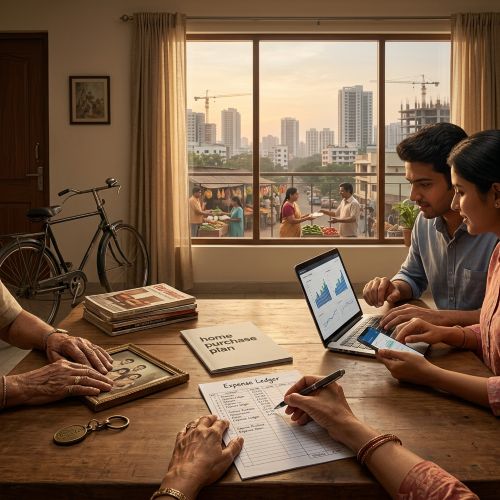
housing affordability India
For a long time, the middle-class dream was almost universally understood.
Study hard.
Get a stable job.
Buy a home.
Own a car.
Give your children a better education.
Save for retirement.
Take a holiday once in a while.
And eventually, feel financially secure.
It wasn’t necessarily a luxurious life.
It was a predictable one.
But ask a young professional today what financial security looks like, and you may hear something very different.
“Can I afford a house without spending 25 years paying for it?”
“Can I have children without sacrificing everything else?”
“Should I buy a house or keep renting?”
“Can I save for retirement while paying an EMI?”
“Why does earning more not seem to make life proportionately easier?”
And perhaps the biggest question:
Is the middle-class dream simply being delayed—or is the dream itself changing?
The Dream Hasn’t Disappeared. The Price Tag Has Changed.
It’s important not to exaggerate the situation.
India isn’t a country where everyone is becoming poorer.
There are enormous opportunities today that previous generations simply didn’t have.
A young person can work remotely.
Start a business from a laptop.
Freelance internationally.
Create content.
Build an audience.
Invest digitally.
Sell products online.
Learn skills without attending an expensive institution.
Technology has created entirely new ways of earning.
At the same time, however, some traditional milestones have become harder to achieve—particularly in India’s major cities.
And that creates an unusual contradiction:
There are more ways to earn, but also more expensive things to aspire to.
The House That Keeps Moving Further Away
For generations, owning a home represented security.
You weren’t just buying four walls.
You were buying stability.
A place for your family.
An asset for retirement.
Something you could eventually pass to your children.
But housing affordability has become one of the biggest questions facing younger Indians.
Recent reporting has highlighted how rising property prices and limited affordable housing are encouraging more young adults to remain with their parents.
And this isn’t simply a matter of young people refusing to grow up.
Sometimes it’s mathematics.
A person may have a respectable salary and still discover that a home in the city where they work costs many multiples of their annual income.
That’s when the dream changes.
Instead of:
“When will I buy a home?”
the question becomes:
“Do I actually need to own one?”
Renting Isn’t Necessarily Failure
This is an important mindset shift.
For decades, renting was sometimes treated as throwing money away.
But ownership isn’t automatically financially superior.
Buying a home can mean:
- A large down payment
- A long-term loan
- Interest payments
- Maintenance
- Property taxes
- Registration costs
- Limited mobility
Renting can offer flexibility.
You can change cities for a job.
Move closer to work.
Downsize.
Relocate when your circumstances change.
For a young person whose career is still developing, flexibility can have real financial value.
The middle-class dream may therefore evolve from:
“Everyone must own a house.”
to:
“Everyone should have secure, affordable housing that fits their life.”
That’s a very different idea.
The Cost of Education Changed the Equation
Then there’s education.
Parents want their children to have opportunities they didn’t have.
That often means better schools, coaching, university education, professional qualifications and additional skills.
But education is increasingly an investment that families think about financially.
And parents aren’t only asking:
“What will this degree teach my child?”
They’re also asking:
“Will it actually improve their earning potential?”
That’s a significant change.
Education used to be seen primarily as a pathway to employment.
Today, young people are increasingly evaluating education alongside:
- Skill development
- Entrepreneurship
- Freelancing
- Digital careers
- International opportunities
- Online learning
- AI-assisted work
The definition of a “good career” is expanding.
The Car Isn’t Quite the Same Dream Either
Previous generations often associated adulthood with buying a car.
Today, younger consumers may ask:
Do I really need one?
What will EMI cost?
What about fuel?
Insurance?
Parking?
Maintenance?
Could I use public transport?
Could I rent a vehicle when I need one?
Could I buy a pre-owned car instead?
This isn’t necessarily anti-car.
It’s simply a shift from ownership as status to ownership as utility.
And that shift is happening across many categories.
Why Buy New When You Can Buy Smart?
Here’s where the second-hand economy becomes particularly interesting.
If the traditional middle-class dream is becoming more expensive, consumers have another option:
Get the same utility without always paying the full new-product price.
Consider furniture.
A young couple setting up their first home doesn’t necessarily need a brand-new ₹50,000 dining table.
A student moving into a hostel may not need brand-new furniture.
A photographer learning the craft doesn’t necessarily need the newest camera.
Someone starting a home gym may not need every piece of equipment fresh out of the box.
Someone who wants to read 20 books doesn’t need to buy 20 brand-new books.
Buying pre-owned can reduce the initial cost significantly—provided the buyer checks condition, authenticity, safety and value carefully.
This is where second-hand marketplaces become more than a sustainability story.
They’re a financial tool.
The Other Side of the Equation: Selling What You Already Own
There’s another part of the middle-class financial problem that doesn’t get enough attention.
We often focus on:
How do I earn more?
But another question is:
How much value is already sitting around me?
Look around your home.
An old phone.
A laptop.
Books.
A bicycle.
Furniture.
A camera.
A gaming console.
A watch.
Fitness equipment.
Musical instruments.
Children’s toys.
Things you don’t use anymore may still be valuable to somebody else.
Selling those products doesn’t make you rich overnight.
But it can create breathing room.
₹5,000 from unused items could help with a bill.
₹15,000 could contribute to an emergency fund.
₹30,000 could help fund a course.
₹50,000 could become part of an investment or a meaningful purchase.
The point isn’t the exact amount.
It’s the change in mindset:
Unused doesn’t have to mean worthless.
But Here’s the Catch: The Middle Class Is Also Spending More
We can’t blame everything on housing and inflation.
Our lifestyles have changed dramatically.
There are now more things to buy than ever before.
Streaming.
Food delivery.
Gaming.
Online shopping.
Travel.
Fitness memberships.
Digital subscriptions.
Premium smartphones.
Smart devices.
Experiences.
And then there is social media.
A person doesn’t just compare their life with their neighbour anymore.
They compare it with thousands of people every day.
The pressure to upgrade is constant.
The New Middle-Class Trap
Perhaps the biggest danger isn’t poverty.
It’s looking wealthy while remaining financially fragile.
A person can have:
A beautiful apartment.
A premium phone.
A new car.
Designer clothing.
Frequent holidays.
Restaurant bills.
Multiple subscriptions.
And still have very little emergency savings.
On the other hand, somebody living a relatively ordinary life may have:
A substantial emergency fund.
Investments.
Low debt.
A paid-off vehicle.
A diversified income.
And financial flexibility.
Which person is wealthier?
The answer isn’t obvious from Instagram.
The Rise of the “Quietly Comfortable”
This may become one of the defining financial trends of the next generation.
Not everyone wants to show wealth.
Some younger people increasingly value:
- Financial independence
- Flexible work
- Experiences
- Time
- Low debt
- Savings
- Investments
- Health
- Family
- Location freedom
The dream isn’t necessarily disappearing.
It’s being rewritten.
And India’s Economic Story Is Still Positive
This distinction matters.
It would be wrong to turn this article into a story about economic doom.
India continues to have strong growth ambitions and enormous opportunities.
The current environment is also not one of runaway inflation. India’s CPI inflation was 4.38% year-on-year in June 2026, while food inflation was 5.32%.
At the same time, the Reserve Bank’s policy environment remains focused on balancing growth with inflation risks. A July 2026 Reuters poll found economists largely expected the policy rate to remain unchanged through 2026 amid growth concerns.
So the story isn’t:
“India is becoming unaffordable.”
It’s more nuanced.
India is becoming more prosperous, but the definition of financial security is changing at the same time.
What Will the Middle-Class Dream Look Like in 2030?
Nobody can predict it perfectly.
But several changes seem plausible.
1. Ownership will become more selective
People may stop asking:
“What can I own?”
and start asking:
“What is actually worth owning?”
2. Renting will become more normal
Not necessarily because people don’t want homes.
But because flexibility may become more valuable.
3. Second-hand will become mainstream
Buying pre-owned won’t necessarily carry the old stigma.
Quality, value and sustainability will matter more than whether something is brand-new.
4. Multiple income streams will become normal
A salary may remain the foundation.
But freelancing, investments, content, digital businesses and other income streams can increasingly sit alongside it.
5. Experiences may compete with possessions
Younger consumers may choose:
A trip over a new television.
A course over a luxury purchase.
Time with family over a larger house.
The ability to work remotely over a more expensive office wardrobe.
The Middle-Class Dream May Become Less About “More”
This is perhaps the most important change.
For decades, progress was measured by accumulation.
Bigger house.
Bigger car.
Better phone.
More furniture.
More possessions.
More status.
The next generation may measure progress differently.
More freedom.
More choices.
Less debt.
More time.
More financial resilience.
And that’s not necessarily a worse dream.
It may actually be a smarter one.
So, Is the Middle-Class Dream Delayed or Disappearing?
Probably neither.
It’s evolving.
The house may come later.
The car may not be necessary.
The expensive wedding may be replaced by something simpler.
The brand-new furniture may be replaced by something pre-owned.
The single salary may be supplemented by multiple income streams.
The definition of success may move away from owning the most and toward having the freedom to choose.
And perhaps that’s the real story.
The middle-class dream was never really about a house, a car, or a particular salary.
Those were symbols.
The deeper dream was always:
Security. Freedom. A better life for your family. And the ability to look at tomorrow without fear.
That dream isn’t disappearing.
But the route to it is changing.
A Smarter Way Forward
You don’t have to reject ambition.
You don’t have to stop wanting a home.
You don’t have to stop enjoying nice things.
You simply need to stop assuming that everything has to be new, owned, upgraded and paid for immediately.
Before making a large purchase, ask:
Can I afford it without damaging my financial future?
Could I rent it?
Could I buy it pre-owned?
Could I buy a smaller version?
Could I wait?
And when something you already own no longer serves you:
Could someone else use it?
That’s where the second-hand economy becomes powerful.
A product doesn’t have to stop being valuable simply because you’ve stopped needing it.
A local marketplace such as ZiHERO can help connect people who want to sell things they no longer need with people looking for useful products at better prices.
The future of the middle class may not be about owning everything.
It may be about using money, possessions and opportunities more intelligently.
And perhaps that isn’t the disappearance of the dream.
Perhaps it’s an upgrade.
Frequently Asked Questions
1. Is the middle-class lifestyle becoming harder to afford in India?
For some households, particularly in expensive urban areas, housing, education and lifestyle costs can make traditional milestones harder to reach. But the picture varies significantly by city, income, family structure and spending habits.
2. Are young Indians still buying homes?
Yes. Homeownership remains an important goal for many people. However, some younger adults are delaying purchases, choosing to rent, staying with family longer, or waiting until their income and career become more stable.
3. Is renting better than buying a house?
Neither is automatically better. Buying can make sense for people who expect to stay in one location for many years and can comfortably afford the total costs. Renting may be preferable when flexibility, mobility and lower upfront costs are more important.
4. Why is buying a home becoming difficult for young people?
The challenge is often the relationship between property prices and income. A home can be technically affordable through a long-term loan but still consume a large proportion of a household’s financial resources.
5. Is buying second-hand a good way to save money?
It can be. Pre-owned products can cost considerably less than new ones, particularly for furniture, books, electronics, bicycles, cameras and other durable goods. Buyers should always inspect condition, authenticity, safety and expected remaining life.
6. Can selling unused things improve financial health?
Yes, although it shouldn’t be confused with a regular income stream. Selling unused possessions can generate additional cash, reduce clutter and recover some of the value already tied up in household goods.
7. Why are young people choosing experiences over possessions?
For some younger consumers, flexibility and experiences provide more perceived value than accumulating physical goods. This isn’t universal, but it is contributing to changing ideas about what financial success looks like.
8. Is the middle-class dream disappearing?
Not necessarily. The traditional version of the dream may be changing, but the underlying goals—security, independence, a comfortable home and a better future—remain relevant.
9. How can middle-class families reduce everyday expenses?
Start with the largest recurring expenses, then look at subscriptions, impulse purchases, unused memberships, transport, dining out and unnecessary upgrades. Buying quality pre-owned goods and selling unused items can also improve household cash flow.
10. What is the second-hand economy?
The second-hand economy involves products being sold, bought, exchanged, reused or passed to new owners rather than being discarded after one person stops using them. It can benefit both household finances and resource efficiency.
Finding a great second-hand deal doesn’t end with buying—it begins a new journey for that product.
One day you might buy a study table, a camera, or a bicycle through ZiHERO. A few years later, when your needs change, someone else may be searching for exactly that same item. By passing it on instead of storing it away, you recover value, help another buyer save money, and keep useful products in circulation.
That’s the beauty of a community marketplace. It’s not just about transactions—it’s about giving good products a longer life and making smarter choices together.
The next great deal isn’t always sitting on a store shelf. Sometimes, it’s already waiting in someone else’s home—and one day, your own unused items could become someone else’s perfect find.